


FCI Standard N° 200 – publication del 17.12.2015 – in force since 1st January 2016 – ITALIAN GREYHOUND
ORIGIN
Italy
DATE OF PUBLICATION OF THE OFFICIAL VALID STANDARD
13.11.2015
UTILIZATION
Racing dog
FCI-CLASSIFICATION
Group 10 Sighthounds. Section 3 Shorthaired sighthounds. Without working trial.
BRIEF HISTORICAL SUMMARY
The little Italian Sighthound descends from small-sized sighthounds that already existed in ancient Egypt at the court of the Pharaohs. Passing through Laconie (Greece), where numerous representations on vases and bowls confirm this, the breed arrived in Italy at the outset of the 5th century BC. Its greatest development occurred during the era of the Renaissance at the court of the nobles. It is not rare to find the Italian Sighthound represented in the paintings of the greatest Italian and foreign masters.
GENERAL APPEARANCE
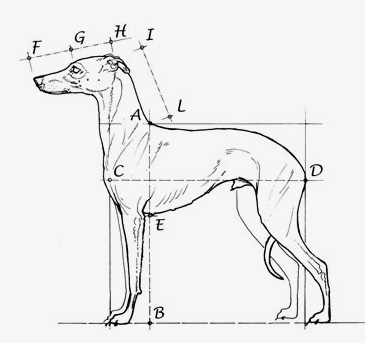
Of slender appearance, its body fits into a square. Although of a small size, it fully characterizes a miniature sighthound, the prototype of refinement and elegance. May be considered as a model of grace and distinction.
IMPORTANT PROPORTIONS
The length is equal to or only just inferior to the height at the withers. Length of skull is equal to half the length of the head. Length of head can reach 40% of the height at the withers.
BEHAVIOUR/TEMPERAMENT
Lively, affectionate, docile.
HEAD
Of elongated shape and narrow
CRANIAL REGION
Skull
Flat with the superior axes of the skull and muzzle parallel. Length of the skull is equal to half the length of the head, which has slightly rounded sides. Lower orbital region well chiselled. Muscles of the head must not show any heavy appearance. Marked eyebrow bones. Not prominent occiput. Only slightly marked median depression.
Stop
Frontal nasal depression only very slightly marked.
FACIAL REGION
Nose
Of a dark colour, preferably black with well-opened nostrils.
Muzzle
Tapered
Lips
Thin and tight, with edges of lips very darkly pigmented
Jaws/Teeth
Jaws elongated with well-aligned incisors crown shape, strong in relation to size of dog. Teeth sound and complete set square to the jaws; scissor bite.
Cheeks
Lean
Eyes
Large, roundish, and expressive, sub-frontally positioned, neither deep-set nor protruding. Iris of dark colour, eye rims pigmented.
Ears
Set very high, small, with fine cartilage, folded in itself and carried well back on the nape and upper part of the neck. When the dog is attentive, the base of the ear is erected and the lobe tends to stand out laterally on the horizontal, position commonly known as “flying ears” or “propeller ears”.
NECK
The nape is slightly arched and broken at its base towards the withers. The throat line is slightly convex. Neck length equal to that of the head. Shaped like a truncated cone, well muscled. Skin lean without dewlap.
BODY
The length is equal to, or barely inferior to the height at the withers.
Topline
Straight profile with slightly arched dorsal-lumbar region. The lumbar curve is merging harmoniously into the line of the rump.
Withers
Quite well defined with closely placed top of shoulders.
Back
Straight, well muscled.
Loin
Slightly arched.
Croup
Very sloping, wide and muscled. Chest: Narrow, solid but elegantly modelled with slight spring of ribs. Deep, let down to the elbows.
Underline and belly
The rather short sternal arch is accentuated and rises without abruptness to the belly.
LIMBS
FOREQUARTERS
General appearance
On the whole straight and vertical with lean muscles.
Shoulder
Very slightly sloping with well developed, long lean and salient muscles.
Upper arm
With a very open scapulo-humeral angle parallel to the median plane of the body. The upper arm is slightly longer than the shoulder blade.
Elbow
Neither out nor tied-in at elbows.
Forearm
Straight. Refined bone structure, flat and lean; in perfect vertical position as much from the front as in profile. Well evident furrow from the carpus to the elbow. Length from ground to elbow, just slightly more than the length from elbow to the withers.
Metacarpus (Pastern)
Dry. Seen in profile it is slightly bent.
Forefeet
Of almost oval shape, small, with arched and closely knit toes. Not voluminous pads, pigmented. Nails black or dark according to coat colour or that of the feet, where white is tolerated.
HINDQUARTERS
General appearance
Well angulated. Seen from behind on the whole straight and parallel. Thigh: Long, lean, not voluminous, with very distinct muscles.
Stifle (Knee)
Solid and firm
Lower thigh
Very sloping, with refined bone structure and well apparent groove in leg muscle. A little longer than thigh.
Metatarsus (Rear pastern)
Seen from behind, must be parallel. Hind feet: Less oval than the forefeet, with arched and clos
Hind feet
Less oval than the forefeet, with arched and closely knit toes; not voluminous pads and nails pigmented like forefeet.
GAIT / MOVEMENT
Springy, harmonious, slightly raised trot, covering the ground. This means that the front legs must be moved forward with good reach and with slightly lifted and bent pasterns. Gallop fast with sharp spring.
SKIN
Fine and tight on all parts of the body except for the elbows where it is slightly less tight.
COAT
Hair
The hair is short, silky and fine all over the body without the slightest trace of fringes.
Colour
Self-coloured in black, grey, and isabella (pale yellowish/beige) in all possible shades. White is tolerated only on the chest and feet.
SIZE AND WEIGHT
Height at the withers
Males and females from 32 to 38 cm
Weight
Males and females: maximum 5 kg
FAULTS
Any departure from the foregoing points should be considered a fault and the seriousness with which the fault should be regarded should be in exact proportion to its degree and its effect upon the health and welfare of the dog.
– Continuous ambling
– Hackney movement
– Movement close to the ground with short steps
DISQUALIFYING FAULTS
– Aggressive or overly shy
– Any dog clearly showing physical or behavioural abnormalities shall be disqualified
– Accentuated convergence or divergence of the facial-cranial axes
– Nose totally or half de-pigmented
– Nasal bridge concave or convex
– Overshot or undershot bite
– Wall eye; total de-pigmentation of eyerims.
– Tail carried over the back; anury or short tail, whether congenital or artificial.
– Multi-coloured coat; white except in chest and feet as mentioned above
– Size below 32 cm or over 38 cm, as well in males as in females
N.B.:
– Male animals should have two apparently normal testicles fully descended into the scrotum.
– Only functionally and clinically healthy dogs, with breed typical conformation should be used for breeding